> ## Documentation Index
> Fetch the complete documentation index at: https://decageo.ai/docs/llms.txt
> Use this file to discover all available pages before exploring further.
# What is the DECA Score?
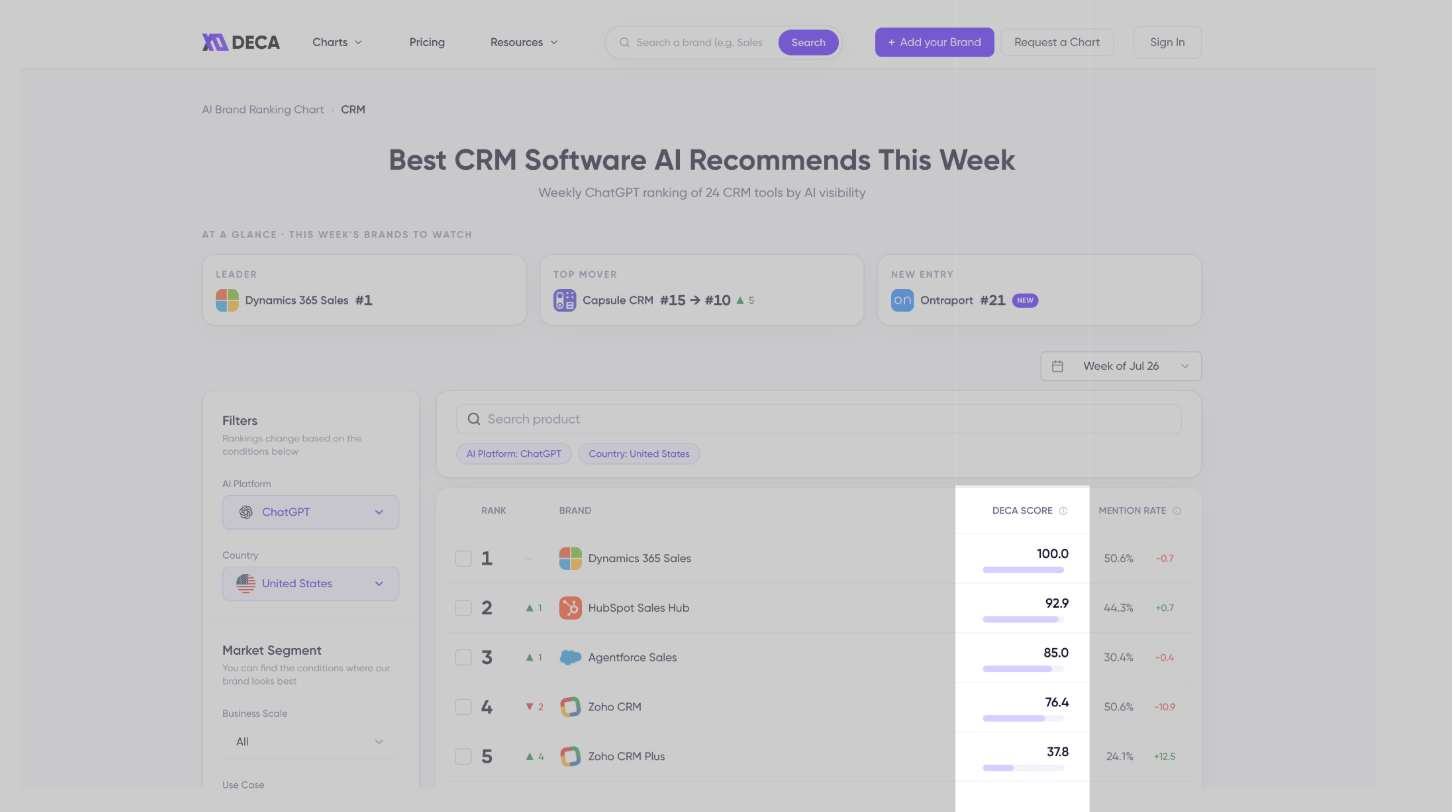
> The DECA Score is a 0–100 measure of how strongly AI recommends a brand in its category — how often it's recommended, weighted by how highly it ranks.
The DECA Score is a 0–100 measure of how strongly AI recommends a brand in its category. It combines two things: how often the brand is recommended, and how high it appears when it is. A score of 100 means the brand was recommended first in every response we collected.
## Overview
Every week, DecaGEO sends hundreds of buyer-like questions to AI for each category, then reads which brands the answers recommend and in what order. The DECA Score condenses all of those answers into a single number per brand, so an entire category can be ranked on one scale.
Only genuine recommendations count. A brand earns points only when AI recommends it as a solution — simple name-drops, negative references, and comparison filler are excluded. The score reflects real AI endorsement, not raw mention volume.
## How the DECA Score is calculated
**Position** is the order in which a brand appears within a single AI response: if AI recommends five brands, the first brand listed is position 1, the second is position 2, and so on.
```text theme={null}
For every weekly response:
points earned = position points # 1st place earns the most,
# last place the fewest,
# not recommended = 0
DECA Score = 100 × points earned ÷ maximum possible points
```
> **Example:** If an AI response lists 5 brands and HubSpot appears first, HubSpot earns 5 points. If it appears third, it earns 3 points. If it doesn't appear at all, it earns 0. Repeat across hundreds of responses, normalize, and you get the DECA Score.
A brand recommended in first position 40% of the time will score higher than a brand recommended in last position 70% of the time — where you appear matters as much as whether you appear.
 ## Why the DECA Score matters
### It measures endorsement, not noise
A rising DECA Score can mean only one thing: AI is recommending you more often, in higher positions. Name presence alone can't move it.
### It's comparable across your whole category
Because the measurement conditions are identical for every brand, the score works as a benchmark. You see not just your own number, but the exact gap between you and every product above you.
### It shows whether your GEO work is landing
The score is refreshed every week under fixed conditions. Ship a change — new content structure, better third-party coverage — and the following weeks tell you whether AI noticed.
## Related metrics
How often you're recommended at all, regardless of position.
Where your score places you in the category, and how that changed this week.
Your rank inside a specific buyer segment, not just the overall chart.
## Why the DECA Score matters
### It measures endorsement, not noise
A rising DECA Score can mean only one thing: AI is recommending you more often, in higher positions. Name presence alone can't move it.
### It's comparable across your whole category
Because the measurement conditions are identical for every brand, the score works as a benchmark. You see not just your own number, but the exact gap between you and every product above you.
### It shows whether your GEO work is landing
The score is refreshed every week under fixed conditions. Ship a change — new content structure, better third-party coverage — and the following weeks tell you whether AI noticed.
## Related metrics
How often you're recommended at all, regardless of position.
Where your score places you in the category, and how that changed this week.
Your rank inside a specific buyer segment, not just the overall chart.