> ## Documentation Index
> Fetch the complete documentation index at: https://decageo.ai/docs/llms.txt
> Use this file to discover all available pages before exploring further.
# How do Rank and weekly movement work?
> Rank is a brand's chart position in its category, determined by DECA Score. Weekly movement shows how that position changed since last week.
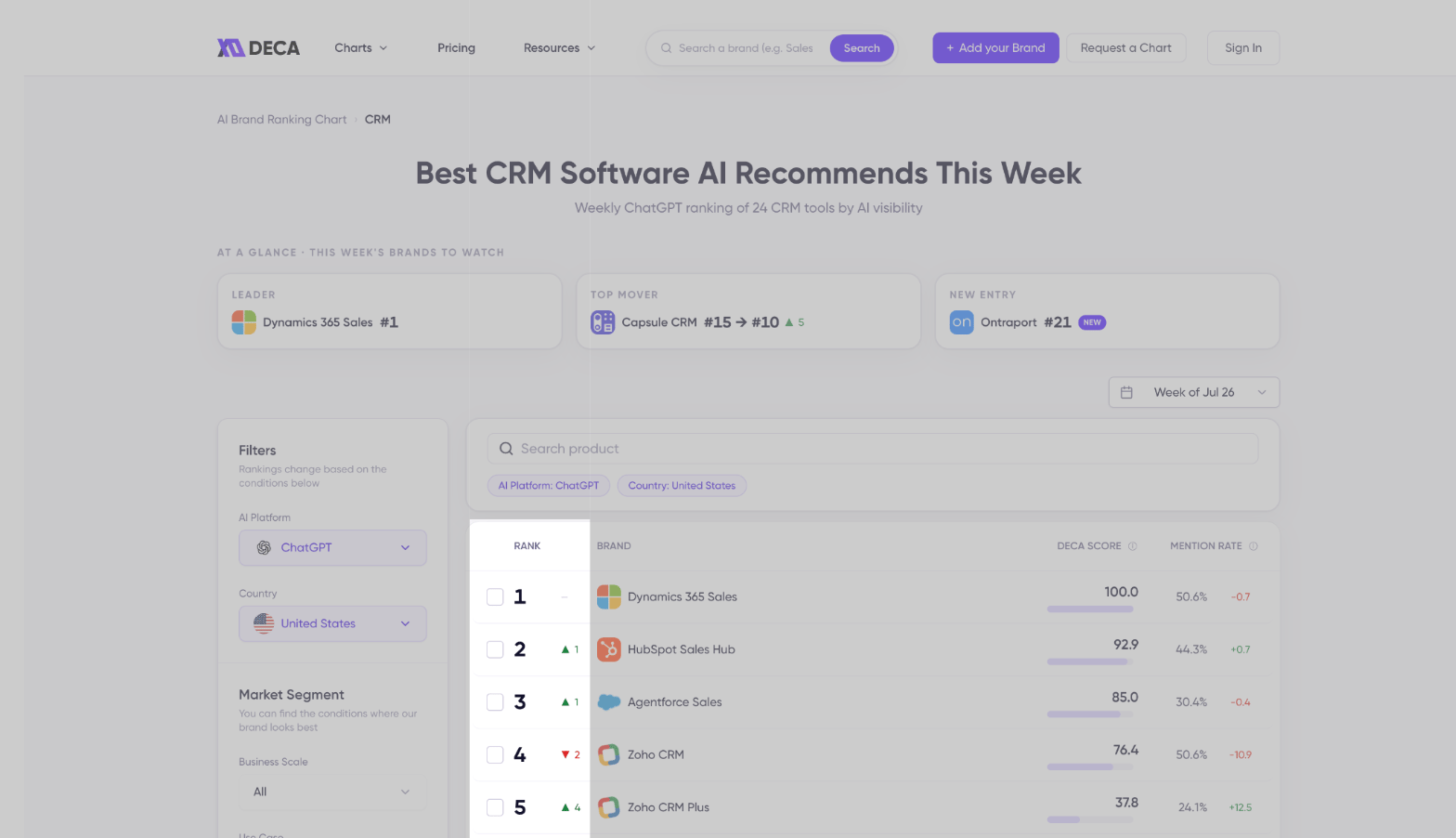
Rank is a brand's overall position on its category chart, determined by [DECA Score](/docs/metrics/deca-score) — Rank 1 is the highest DECA Score in the category. Weekly movement is the change in that position since last week, shown next to every rank.
## Overview
Every chart is re-ranked in the same weekly cycle the scores are collected in, so rank and movement always describe the same week of AI answers.
The chart ranks every brand AI recommends — there is no artificial cutoff like a Top 10 or Top 100. If a brand isn't on the chart, AI hasn't recommended it as a solution in this category's context yet.
## How Rank and movement are determined
```text theme={null}
Rank = position when sorted by DECA Score # 1 = highest
Weekly movement = last week's rank − this week's rank # + = climbed
```
Products with the same DECA Score share the same rank, and the ranks that follow skip the tied places.
 ## How to read the movement signals
Every category chart opens with three signals for the week:
| Signal | What it means |
| :------------ | :------------------------------------------------------------------------------------------------ |
| **Leader** | The week's Rank 1 in the category |
| **Top Mover** | An already-ranked product climbing on real gains of its own — not just because rivals dropped off |
| **New Entry** | A product landing on the chart for the first time |
A one-week jump is a data point; a multi-week climb is a trend. Check [Chart History](/docs/using/chart-history) before treating a spike as momentum.
## Why Rank & weekly movement matter
### Rank is the shortlist, made visible
When AI answers a category question, it names a handful of brands in order. Rank aggregates those orders across hundreds of answers — the closest thing there is to the shortlist AI puts in front of buyers.
### Movement separates news from noise
Because Top Mover status requires gains of a product's own, movement flags what actually changed in AI's behavior this week — not just reshuffling caused by someone else's drop.
### It's the scoreboard for your GEO work
Scores explain the *why*; rank is the outcome. After you ship changes, the following weeks' movement is the simplest read on whether the category order shifted in your favor.
## Related metrics
The 0–100 score that determines rank order.
How often you're recommended at all, regardless of position.
Your rank inside a specific buyer segment, not just the overall chart.
## How to read the movement signals
Every category chart opens with three signals for the week:
| Signal | What it means |
| :------------ | :------------------------------------------------------------------------------------------------ |
| **Leader** | The week's Rank 1 in the category |
| **Top Mover** | An already-ranked product climbing on real gains of its own — not just because rivals dropped off |
| **New Entry** | A product landing on the chart for the first time |
A one-week jump is a data point; a multi-week climb is a trend. Check [Chart History](/docs/using/chart-history) before treating a spike as momentum.
## Why Rank & weekly movement matter
### Rank is the shortlist, made visible
When AI answers a category question, it names a handful of brands in order. Rank aggregates those orders across hundreds of answers — the closest thing there is to the shortlist AI puts in front of buyers.
### Movement separates news from noise
Because Top Mover status requires gains of a product's own, movement flags what actually changed in AI's behavior this week — not just reshuffling caused by someone else's drop.
### It's the scoreboard for your GEO work
Scores explain the *why*; rank is the outcome. After you ship changes, the following weeks' movement is the simplest read on whether the category order shifted in your favor.
## Related metrics
The 0–100 score that determines rank order.
How often you're recommended at all, regardless of position.
Your rank inside a specific buyer segment, not just the overall chart.