Line competitors up, and see what none of you have yet.
Pick two to four products from the same category and put them on the same weekly data. Every row comes back tagged — shared across the set, actively contested, unique to one of them, or a gap none of them have filled. The last one is the part a ranking never tells you.
Building a comparison needs an account. Two of the four views are free.
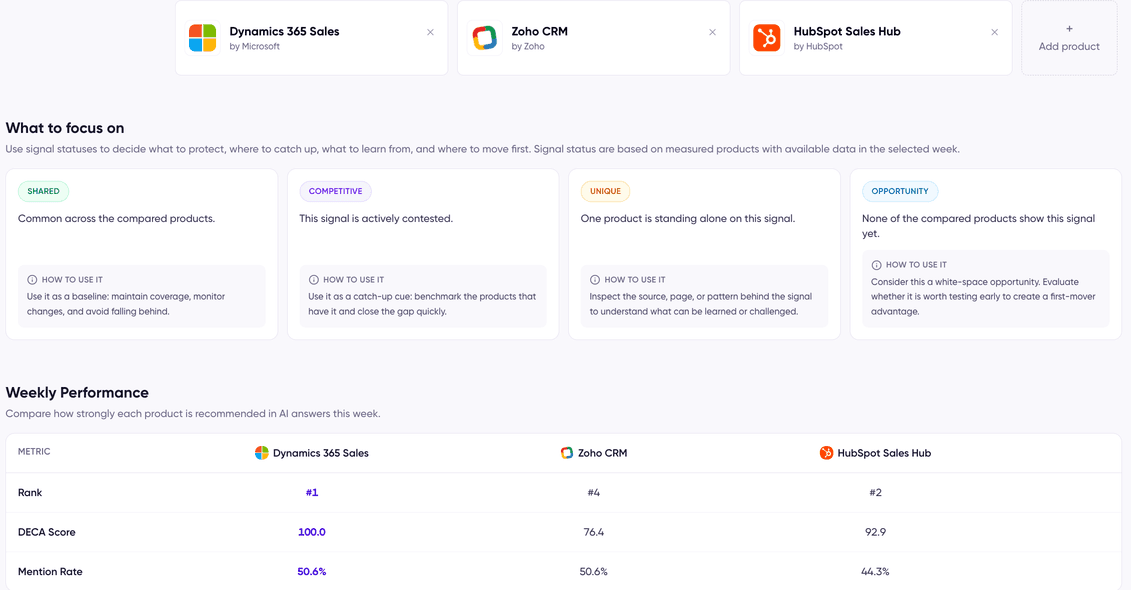
The set you built, the four signal tags that sort every row, and the weekly numbers underneath.
What you see
- A set you choose — two to four products from one category, with or without your own brand in it.
- Every row tagged Shared, Competitive, Unique, or Opportunity, with what to do about each.
- Weekly Performance: rank, DECA Score, and mention rate side by side, leader highlighted.
- Segment Position: where each product stands per buyer type, so you see who owns which buyer.
- Off-Page Citations and On-Page GEO Patterns for the same set — the sources and page signals behind the gap.
How this is measured
Nothing here is a separate measurement. Compare reads the same weekly data behind the public rankings — the same prompts, the same recorded answers, the same cited pages — and lines it up for the products you picked.
The signal tags are computed across your set, not across the whole category. That is why Opportunity means “none of these four” rather than “nobody anywhere” — change the set and the tags change with it.
Common questions
How do I build a comparison?
From the weekly chart. Check the products you want on the AI ranking chart and press Compare in the tray at the bottom — two to four from the same category. Your own brand does not have to be one of them; lining up three competitors to see what they share is a legitimate use.
What do the four signal tags mean?
Shared — every product in the set has it, so it is the baseline you cannot fall behind on. Competitive — actively contested, so it is a catch-up cue. Unique — one product stands alone, worth inspecting to learn from or challenge. Opportunity — none of them have it yet.
What is the Opportunity signal for?
It is the one that is hard to get any other way: a signal none of the compared products carry. Instead of only telling you where you are behind, it points at the space nobody in your set has taken. Whether it is worth moving first is your call — but you cannot weigh a gap you were never shown.
What can I compare?
Four views on the same weekly data: Weekly Performance (rank, DECA Score, mention rate), Segment Position (each product's standing per buyer type), Off-Page Citations [Pro] (which source types AI cites for each), and On-Page GEO Patterns [Pro] (what their most-cited pages carry). Each view has its own signal filter.
Do I need a paid plan?
You need an account to build a comparison, and the first two views work on the free tier. The citation and on-page views are Pro. The underlying charts and product pages stay public either way.
Related features
All featuresAI visibility rankings
A weekly ranking of every brand AI recommends in your category, with the rank movement behind it.
Learn moreCitation sources
Which reviews, forums, and media AI cites when it recommends a brand — and which ones never mention you.
Learn moreCompetitor comparison
One product, split by buyer type. A category has a different AI ranking for a small business than for an enterprise.
Learn more