See which reviews, forums, and media AI cites for a brand.
When AI recommends a product it cites both the vendor's own pages and pages other people wrote. The first group is yours to fix whenever you like. The second is the part you cannot author, and the part a buyer reads as independent. DecaGEO records every URL cited in the answers we collect each week and separates the two, so you can see which outside sources your category runs on, and which of them have never mentioned you.
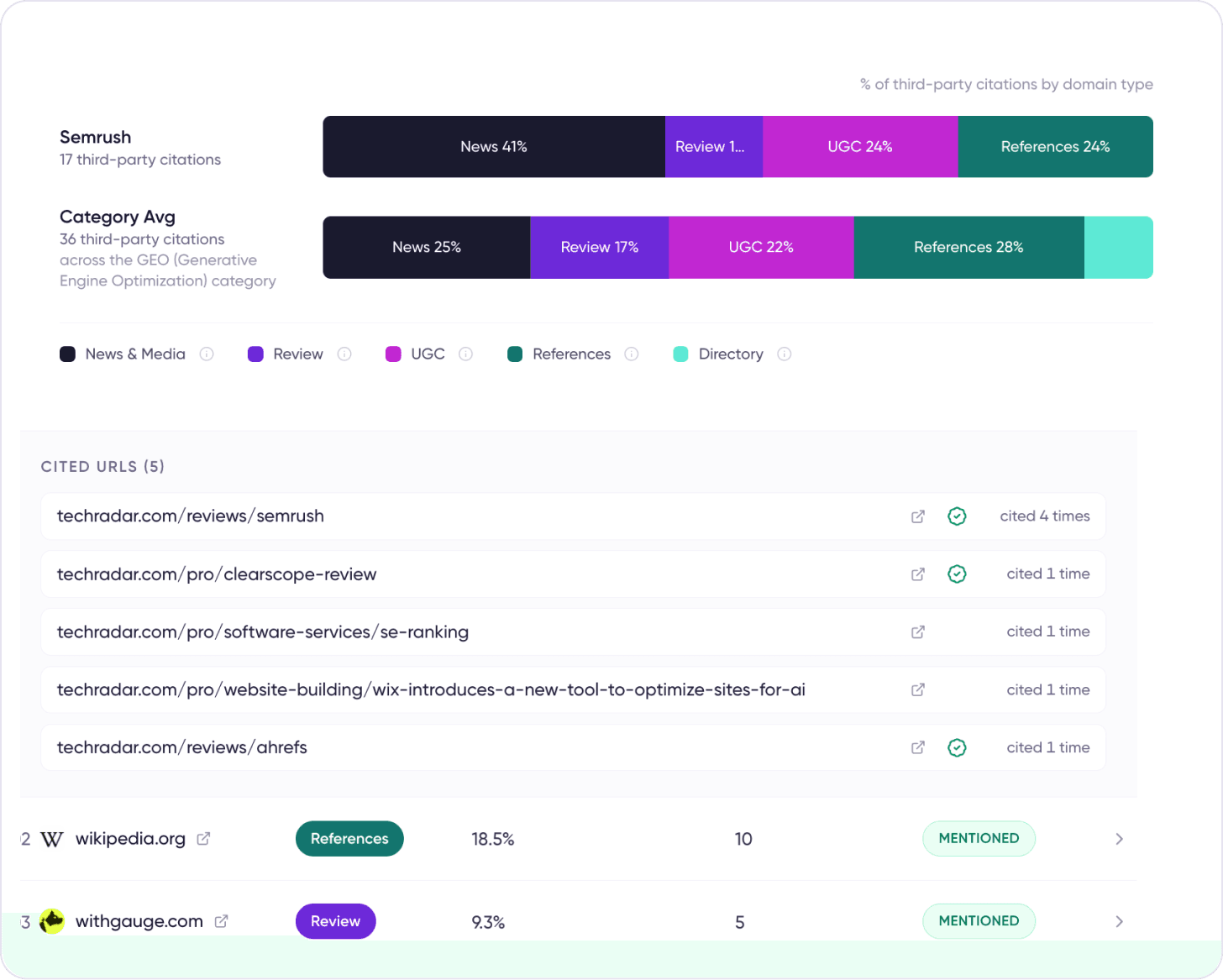
The citation breakdown for one product: which domain types AI cited, and how that compares with the category.
What you see
- Every domain AI cited when it recommended a product, with the exact URLs behind each one.
- The split by source type — review sites, communities and forums, news and media, directories, and the brand’s own pages.
- How that split compares with the rest of your category, so you can tell a gap from a norm.
- The domains that cite the leaders but have never mentioned you — the shortest list of places worth working on.
- Week-by-week movement, so you can see whether a new mention actually changed anything.
How this is measured
Every week we run buyer-style prompts on AI across each category we cover — segmented by what the buyer is trying to do, how big their company is, and what they are trying to improve. We record the full answer, including every source the model cited to produce it.
A citation here means a URL that appeared in a real answer we captured, not a link we found by crawling. That is why the list differs from a backlink report: it reflects what AI actually used. Nothing is self-reported and no brand pays to be listed.
Common questions
Which sources does AI cite when it recommends a brand?
Both kinds, and the mix shifts by category. Vendor-owned pages — product pages, docs, help centres, company blogs — carry the largest share of citations in every category we measure. Around them sit review sites, community threads, news and media, directories, and encyclopedias. DecaGEO records every URL cited in every answer we collect, groups them by domain type, and shows the actual split for your category rather than a rule of thumb.
If my own pages get cited most, why look at third-party sources at all?
Because they are the half you cannot write. Your own pages are already yours to fix — you can rewrite a title or add a comparison table this afternoon. A review profile, a forum thread, or a round-up post is written by someone else, takes longer to change, and is what a buyer treats as independent. So the useful question is not which group is bigger, it is which outside pages your category runs on, and whether you appear on them. Off-Page Citations lists the ones that cite the leaders but have never mentioned you.
Where do I find this in DecaGEO?
Open the weekly chart for a category, click any ranked product, and pick the Off-Page Citations tab — that is what this page describes, under the name it carries inside the product. It is on every ranked product and does not need a paid plan. If you already know the brand you want, search for it and go straight to its page.
How is this different from backlink tracking?
A backlink is a link to your site. A citation is a source AI actually used to build an answer, whether or not it links to you. The two overlap but are not the same list, and the second one is what decides whether AI names you. We only count URLs that appeared in a real AI answer we recorded.
Can I see which sources my competitors get cited from?
Yes. Every ranked product in a category has the same citation breakdown, so you can compare yours against the leaders and see which domains cite them but not you. Competitor comparison lines several products up on the same weekly data.
How often is this updated?
Every week. We run the category prompts on a weekly cycle and publish what came back, so the citation list reflects the answers AI gave that week rather than a one-time snapshot.
Related features
All featuresAI visibility rankings
A weekly ranking of every brand AI recommends in your category, with the rank movement behind it.
Learn moreCompetitor comparison
One product, split by buyer type. A category has a different AI ranking for a small business than for an enterprise.
Learn moreCompare
Pick 2–4 products and line them up. Every row is tagged shared, contested, unique — or a gap none of them have filled yet.
Learn more