A category does not have one AI ranking. It has one per buyer.
Ask AI the same category question as a small business, then as an enterprise, and you get different names back. That means an overall position hides the buyers you are losing. We publish the ranking inside each buyer type — so you can see exactly where a competitor is named and you are not.
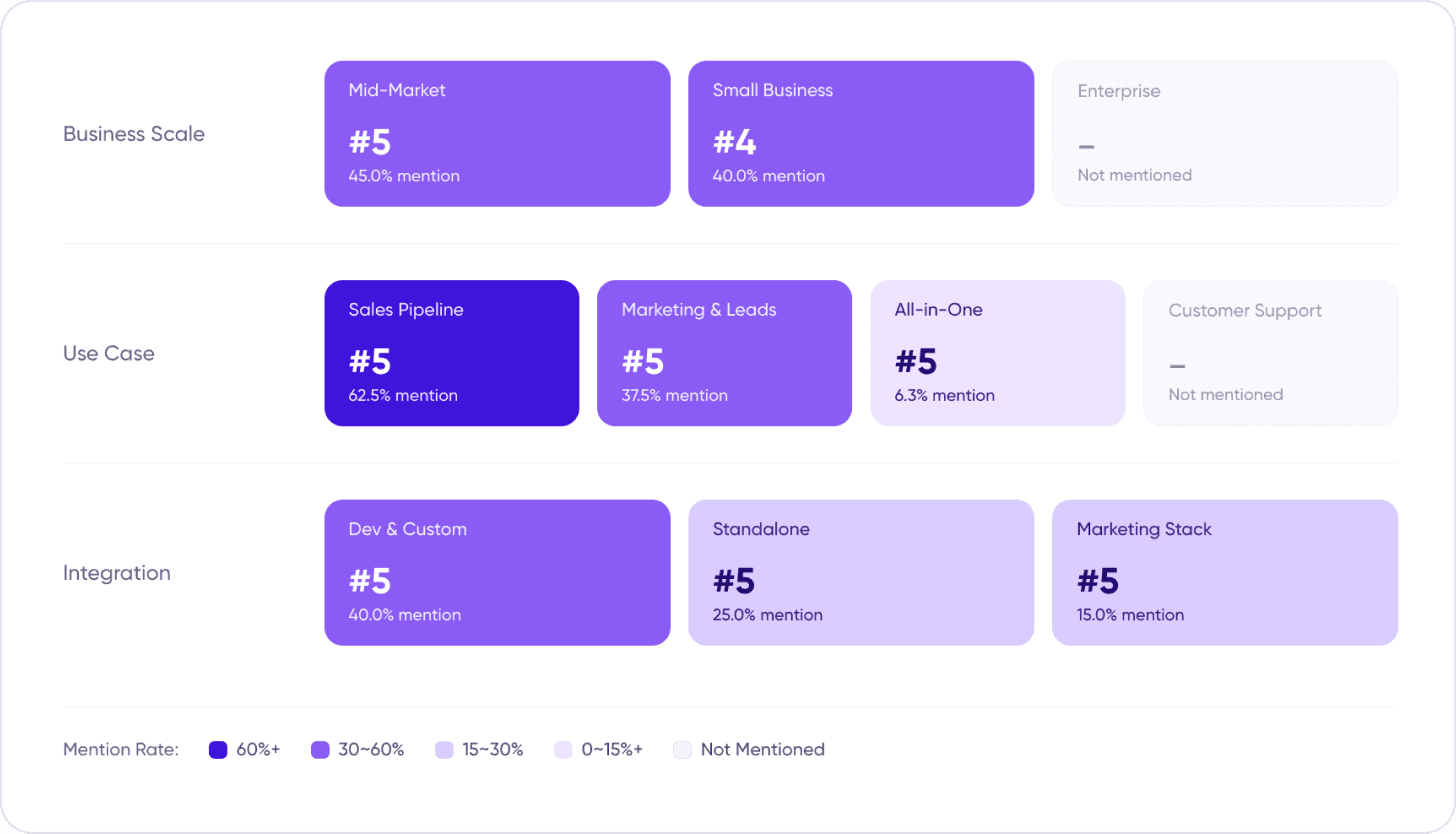
One product's rank inside each buyer type. Open a competitor's and read the same grid to see which buyers go to them.
What you see
- Your rank inside every buyer type AI splits the category into — not one overall number.
- The mention rate in each, so you can tell a type you barely appear in from one you own.
- The buyer types where you are not named at all — usually the shortest, clearest gap list you will get.
- The same grid for any competitor, read side by side to see which buyers go to them instead.
- Movement week to week, because the cuts stay fixed while the answers change.
How this is measured
We research each category first and build the buyer cuts that actually exist in it — company size, what the buyer is trying to do, and what the tool has to work with. Every prompt is written from one of those cuts, so a ranking exists inside each of them rather than being averaged away.
The cuts and the prompts stay fixed week to week. When a position moves inside a buyer type, something moved in what AI found for that buyer — not in how we asked.
Common questions
What is a buyer type here?
A cut of the same category question, asked the way a different buyer would ask it — by how big their company is, what they are trying to do, and what they need it to work with. AI answers those cuts differently, so a category does not have one ranking; it has one per buyer type. Elsewhere this idea shows up as a persona, used to generate prompts. We publish the ranking inside each one.
Why does my rank change between buyer types?
Because AI is answering a different question each time. A tool that leads the answer for a small business can be absent from the enterprise version of the same question, and the reverse happens just as often. A single overall position hides exactly the buyers you are losing.
How do I use this against a specific competitor?
Open both products and read the same grid: the buyer types where they are named and you are not are the ones costing you deals. Compare puts two to four products on the same weekly data side by side; the Segment Position tab is the same view for one product at a time.
Do I need to sign in to see this?
The per-product view is public — every ranked product has its Segment Position tab, on the free tier. Lining several products up side by side in Compare needs an account.
Where do the buyer types come from?
Not from us guessing. We research each category, build the buyer cuts that actually exist in it, and write the prompts from those. The cuts stay fixed week to week, so a move in the grid is a move in the answers rather than a change in how we asked.
Related features
All featuresAI visibility rankings
A weekly ranking of every brand AI recommends in your category, with the rank movement behind it.
Learn moreCitation sources
Which reviews, forums, and media AI cites when it recommends a brand — and which ones never mention you.
Learn moreCompare
Pick 2–4 products and line them up. Every row is tagged shared, contested, unique — or a gap none of them have filled yet.
Learn more