See what the pages AI cites have in common.
Advice about writing for AI is easy to find and hard to check. So we start from the other end: we record the pages AI actually cited in your category this week, read them, and audit them pattern by pattern — with the real lines from each page, so you can see what a cited page does instead of reading a rule about it.
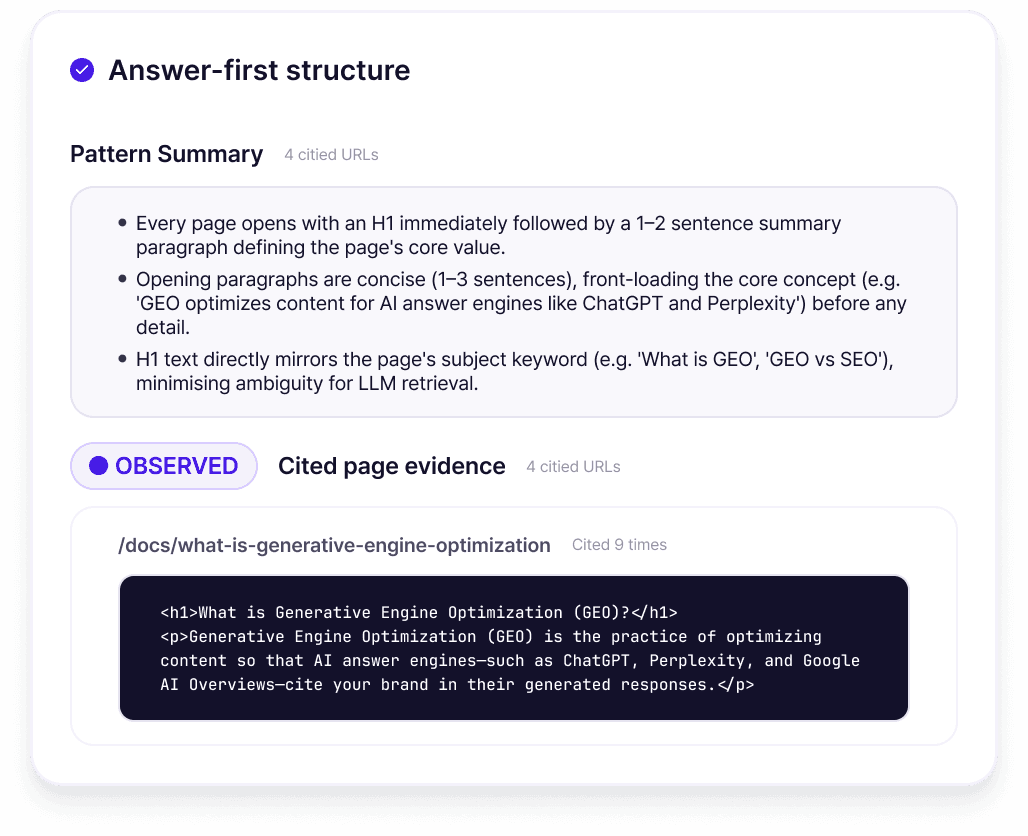
One pattern audited across the cited pages, with the page's own lines shown as evidence.
What you see
- The pages AI cited in your category — the real sample, not a checklist someone wrote.
- Each pattern audited across them: answer-first structure, headings that use the question’s words, publish dates, comparison content, structured data, FAQ blocks.
- How many of the cited pages carry each pattern, so you can tell a norm from a nice-to-have.
- The actual lines from the page as evidence — the heading, the markup, the opening paragraph.
- Which patterns your own cited pages are missing, which is the shortest version of a to-do list.
How this is measured
The page list comes from the answers themselves. Every week we record every source AI used to build its recommendations in a category, then fetch those pages and read what they carry. Nothing here is derived from a generic best-practice list.
That means the sample is small on purpose and specific to your category — pages that already won a citation there, rather than pages that rank well somewhere else.
Common questions
What counts as a pattern here?
Something a page does that we can check and you can copy: an answer stated in the opening lines rather than after a preamble, a heading that uses the words of the question, a published date, comparison content, structured data, a FAQ block. We audit the pages AI actually cited in your category against each one and show which carry it.
How do you know which pages AI cited?
We do not guess. Every week we record the sources AI used to build its answers, so the page list is what actually appeared — then we read those pages and audit them. That is the difference from a generic content checklist: the sample is pages that already won a citation in your category.
Do I get the evidence, or just a verdict?
The evidence. Each pattern shows the pages that carry it and the actual lines from the page — the heading, the markup, the opening paragraph. You can see what "answer-first structure" looks like in a page that got cited instead of reading a definition of it.
Does this tell me what to change on my own page?
It shows you the gap. The patterns the cited pages carry and yours does not are the list. For a guided pass over one page of your own — including whether a bot can read it at all — run the AI visibility diagnostics check.
Which page types get cited most?
It varies by category, but the split is not even: pricing and feature pages tend to be cited far more often than blog posts. We published the rates behind that in Which Pages ChatGPT Actually Cites.
Related features
All featuresAI visibility rankings
A weekly ranking of every brand AI recommends in your category, with the rank movement behind it.
Learn moreCitation sources
Which reviews, forums, and media AI cites when it recommends a brand — and which ones never mention you.
Learn moreCompetitor comparison
One product, split by buyer type. A category has a different AI ranking for a small business than for an enterprise.
Learn more