

Is GEO worth it? Two studies published in 2026 split the question in half. In a testbed peer-reviewed at KDD 2026, edits that inject persuasion into body text lowered visibility at every stage of a realistic search pipeline. Edits that surface real facts in titles, headings, and markup raised retrieval visibility by 22% on average. And an August preprint from a security research group showed the most explicit of those edits can now be detected. The setup resembles an audition with three rounds, where almost all GEO advice coaches the final performance. The KDD testbed suggests the contest is mostly settled in round one, before the judge hears anyone sing.
How much of the web is already rewritten for AI?
GEO-Flag’s authors at the CISPA Helmholtz Center for Information Security put a number on how common optimizing pages for AI answers has become. The researchers started from 1,000 real user queries, collected the pages that Google Search and Gemini’s grounded retrieval actually surfaced for those queries, and ran 10,095 of them through their detector between July 28 and 31, 2026. It flagged 8.9% of pages overall. Among pages that had been modified during 2026, the rate was 16.4%, roughly one page in six (GEO-Flag, arXiv preprint, August 2026). The authors describe these numbers as empirical estimates rather than ground truth, since live pages carry no labels, and a detector this good can still inflate a wild-sample estimate with false positives when the true rate is low. The steadier signal is the gap between the two figures. Pages modified in 2026 carry the pattern at nearly twice the base rate, and false flags would land on both groups roughly alike. So site owners have already answered the title’s question with their budgets. The more interesting question is whether the work being paid for moves the numbers it promises to move.What happened when 10 GEO tactics faced a full search pipeline
An AI answer is assembled in stages. The engine searches a large corpus and shortlists candidate pages (retrieval), reorders that shortlist (reranking), then writes the answer and chooses citations (generation). The original GEO paper from Princeton, presented at KDD 2024, measured the last stage. Its researchers handed candidate sources directly to the model and recorded which ones got cited, and the field’s most quoted finding came from that setting. Adding statistics, quotations, and citations lifted visibility by as much as 40%. SAGEO Arena, the testbed behind the KDD 2026 result, was built by a team at Yonsei University to ask what those same edits do to the stages that come first. The team indexed 171,003 web documents, ran all three stages over them, and pushed 10 popular tactics through the full pipeline. Applied to body text, those tactics degraded performance across the board. Retrieval hit rate fell 9% on average and reranking fell 16%, with citation rate down 6% (SAGEO Arena, KDD 2026). Individual tactics fared worse. AutoGEO, an automated optimizer that learns from engine citation patterns, cut retrieval hit rate by 36% and dropped average rank by 22 positions within the testbed’s 100-candidate retrieval pool when applied to body text. Loading in technical terms cost 14%, and unusual vocabulary cost 8%. The mechanism is not mysterious. Retrieval in the testbed matches a page against the words of the query, and padding the text with persuasive framing, borrowed authority, and inserted numbers dilutes exactly the terms the matcher is looking for. The page becomes more impressive to a reader who arrives and less findable for the query that would bring one. Structure edits moved the other way. Rewriting titles, meta descriptions, and headings to carry the page’s actual entities and facts raised retrieval hit rate by 22% on average and lifted average rank by 2.7 positions (SAGEO Arena, KDD 2026). The paper’s own example is compact. A title reading “Panel Clarifies Advice” becomes “IOM Panel Clarifies Vitamin D Guidance,” and nothing about that edit is a trick. The information was already on the page. The edit moves it to where the matching happens.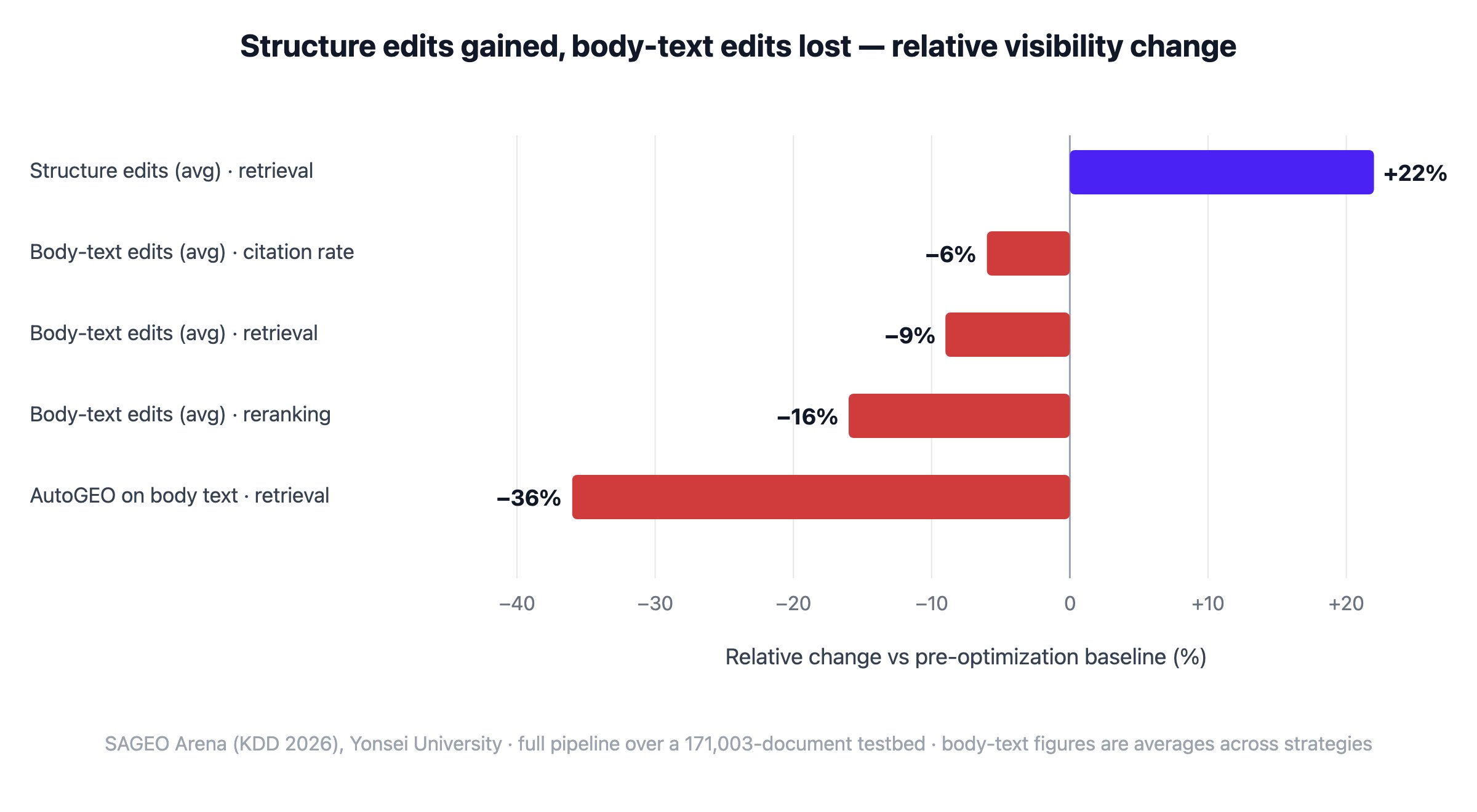
Relative visibility change by edit type in the SAGEO Arena testbed (KDD 2026). Body-text figures are averages across strategies; AutoGEO is the single worst case.
The most explicit edits are also the easiest to flag
Detection is the second half of the story. The CISPA team built its benchmark from 3,200 webpages spanning 400 queries and four domains, covering eight families of GEO optimizers, including stealth variants designed to hide the pattern and pages optimized by human annotators rather than tools. Their training approach pairs two versions of the same page, one merely polished with AI and one optimized for AI engines, so the model learns the difference between the two rather than the general smell of machine writing. Detection reached an F1 score of 0.944 (GEO-Flag, arXiv preprint, August 2026). What gets flagged most reliably is the explicit persuasion layer. Injected statistics, authority phrasing, and instructions aimed at the model are the strongest signals the detector reads, and those are edits that also tested poorly in the SAGEO Arena pipeline. The overlap is not total. AutoGEO’s sparse rewrites slip past detectors more often than any other family, and they also produced the deepest retrieval losses in the testbed, so evading the flag bought nothing. For anyone budgeting this work, the two results run in the same direction. The explicit half of GEO is measurably counterproductive and identifiable, and the subtle half tested even worse on visibility. Search has run this sequence before. Keyword stuffing worked until detection matured, and the practice that survived was the one that made pages genuinely easier to index. None of the AI engines has announced GEO filtering, and neither paper claims deployment is coming. What changed in August 2026 is that the capability now exists in public research.Persuasion edits and structure edits, side by side
Sources: SAGEO Arena (KDD 2026) for visibility effects, GEO-Flag (arXiv preprint, August 2026) for detection behavior. Examples paraphrased from both papers.
Our retrieval logs point the same way
The testbed’s central claim, that visibility is settled early and on structure, is one we can check against production data. When DecaGEO tracked 31,200 vendor pages retrieved by ChatGPT in the week of August 8, 2026, 99.7% of cited URLs had appeared on the model’s search results page, and only 1.2% of citations came from a page the model actually opened before answering. Pages were winning or losing on their titles, URLs, and snippets, mostly unread. The same logs showed pricing pages earning citations at 34.5% of retrievals while blog posts earned 6.1% (DecaGEO retrieval logs, week of August 8, 2026). A pricing page is close to pure structure. Its URL names its purpose, its title carries the brand and the question it answers, and its content is a fact table. Part of its lead is query intent, since commercial questions pull pricing pages into the results to begin with, and a one-week window proves nothing on its own. It is still the shape the testbed measured, a page whose purpose is legible before anyone reads it.What the research suggests building
The practical reading of both papers is a reallocation, not a verdict on GEO as a whole. Neither paper prices the work, so this is a ranking of tactics rather than an ROI table. If the testbed generalizes to production engines, time spent decorating body text has a low expected return and time spent on structure has a positive one. Detection, if any engine ever deploys something like it, runs in the same direction. The specific work the data supports looks like this:- Move real facts into titles, meta descriptions, and headings. Named entities, numbers, and the question the page answers. This was the single most effective intervention in the SAGEO Arena testbed.
- Add schema markup that restates what is visibly on the page. It sits inside the structure scope that gained in the testbed. Google’s own guidance for AI features calls markup optional, so treat it as one part of legible structure rather than a requirement.
- Keep one page per buying question, at a shallow URL. Our citation-rate data and the testbed agree on why this works. The page’s purpose has to be legible before anyone reads it.
- Stop paying for body-text injection. Inserted statistics, authority tone, and model-directed phrasing tested as a cost in the pipeline, and they are the class of edit detectors flag most reliably.