

DECA Weekly AI Recommendation Index
Week of August 2, 2026 · ChatGPT (GPT-5.6), US · 10 categories.
Table 1: DECA Weekly Index headline metrics, week of August 2, 2026. The DECA Volatility Index is the share of ranked brands that moved ±10 rank positions week-over-week (41 of 421 this week, computed among brands present in both weeks). Both weeks were collected on GPT-5.6, so this is the first clean week-over-week comparison since the model change. Source: DecaGEO, ChatGPT (GPT-5.6), US.
What this article covers
This is the second week on GPT-5.6 and the first where both sides of the comparison run on the same model, so normal week-over-week reading resumes here. One change stood out anyway: Profound took GEO #1 from Semrush, a spot Semrush had held in every previous week of our tracking. Beyond that, the week was the quietest in our tracking (9.7% of brands moved ±10 ranks), and the questions the model change opened last week got their first answers: the smaller recommendation set held, all three new #1s defended their spots, and two of last week’s near-flips reverted. Below: the three biggest moves, verdicts on last week’s flags, a category-by-category opportunity map, and how to read a one-week change. Not seeing your category below? Treat this report as a sample chart. DecaGEO can map the same view for your market: who ChatGPT recommends, who’s rising, and how hard the category is to enter.Summary for citation: In DecaGEO’s week of August 2, 2026 data (ChatGPT GPT-5.6, US, 10 categories, 421 ranked brand slots), Profound took GEO #1 from Semrush (now #2, 94.1), the first GEO-native tool to lead the GEO board in our tracking. The recommendation set rose from 399 to 421 but stayed below its GPT-5.4 range (439–493) for a second week, consistent with a smaller GPT-5.6 baseline. All three #1s that changed at the model boundary held their spots (Braze, Jira, Aspire), while two challenges from that week reverted: Help Desk’s gap re-opened from 2 to 7 points and CRM’s from 7 to 18, with HubSpot Sales Hub falling to #4 (−21.5, the week’s biggest fall). Klaviyo closed within 1.1 points of Brevo Marketing Platform for Email #1 after a four-week climb. The DECA Volatility Index hit 9.7%, the lowest in our tracking.
Key takeaway: Two GPT-5.6 weeks now separate signal from model-change noise. The smaller recommendation set and the three new #1s persisted, so they read as the GPT-5.6 baseline. The Help Desk and CRM challenges did not, so they read as one-week moves. A single week’s move is an observation, not a signal to act on — this week’s verdicts are exactly why.
This week’s biggest moves
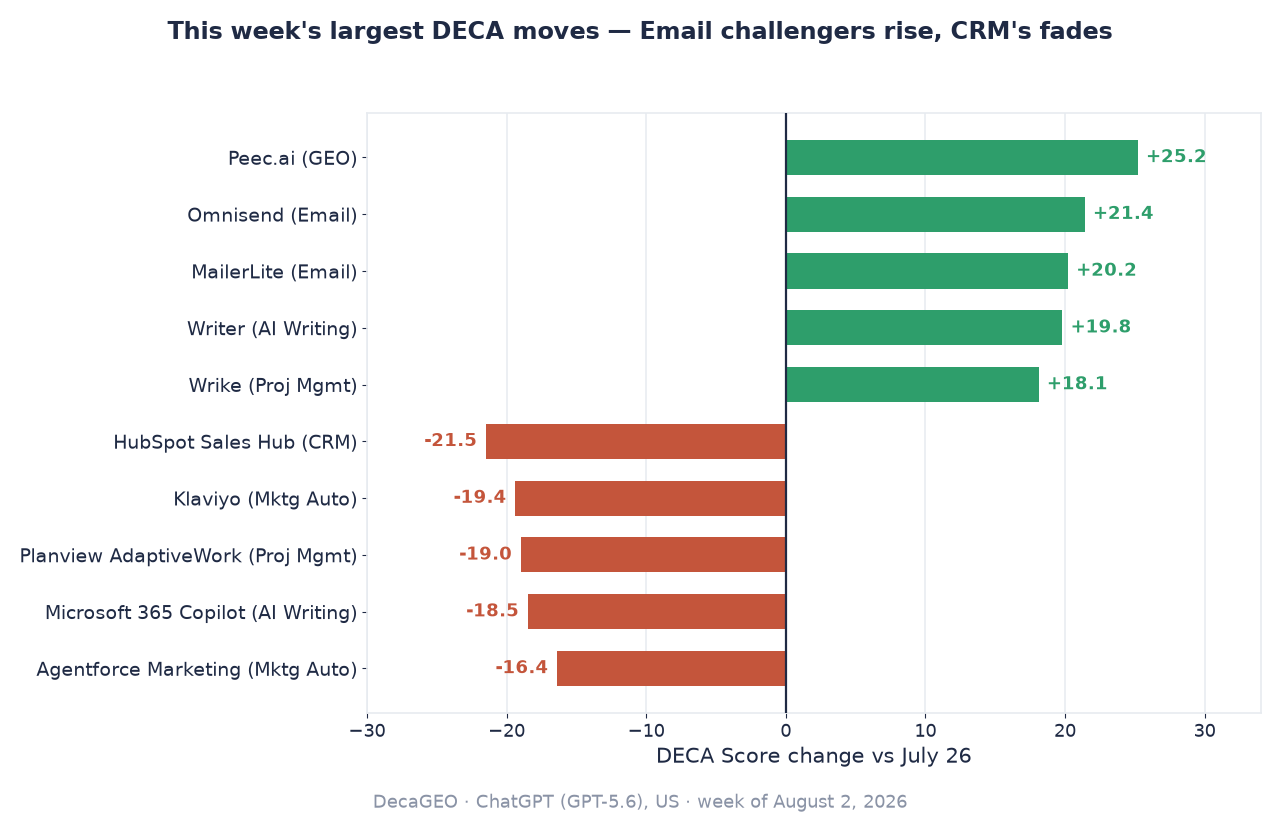
This week's largest DECA Score moves, week of August 2 vs July 26, 2026. Source: DecaGEO, ChatGPT (GPT-5.6), US.
The model-change flags, one week later
Last week’s report flagged every out-of-range reading as a candidate effect of GPT-5.6 and deferred the verdict — the same discipline SEO teams apply after a Google core update, where rankings move while the sites themselves haven’t changed (SISTRIX calls the ChatGPT equivalent a core update too). Here is how each flag resolved after one more week on the new model:
Table 2: First-week verdicts on the flags raised in the model-change report. One confirming week is a first read, not a final one. Each line stays open to revision as GPT-5.6 weeks accumulate.
ChatGPT’s recommendation set settled at a lower level (399 → 421)
The number of brands ChatGPT placed in its recommendation set rose from 399 to 421, recovering part of the model-change drop while staying below every GPT-5.4 week. Two GPT-5.6 readings both under the old range now make the smaller set look like the working baseline rather than a one-week dip. Under the total, GEO (+10), CRM (+6), Email (+6), and AI Image (+7) rebounded while Influencer Marketing thinned again (52 → 44).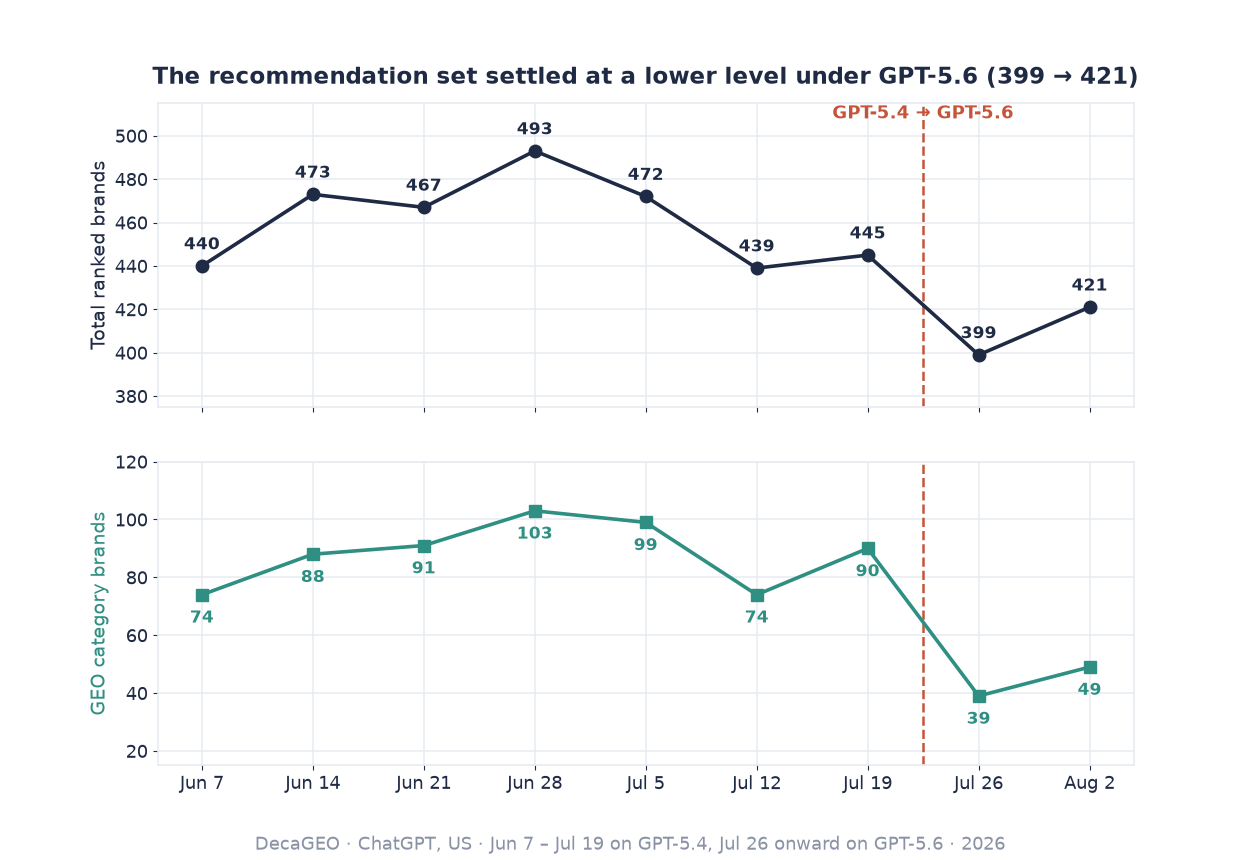
Total ranked brands and GEO category brands, weeks of June 7 – August 2, 2026. Weeks through July 19 collected on GPT-5.4, July 26 onward on GPT-5.6. Source: DecaGEO, ChatGPT, US.
Table 3: Ranked brands per category, weeks of June 28 – August 2, 2026. The last two columns are GPT-5.6 collections. Earlier columns are GPT-5.4. Source: DecaGEO, ChatGPT, US.
Two structural shifts are worth watching across the boundary. AI Image Generators has climbed three weeks straight (25 → 33 → 40) and now sits well above its GPT-5.4 range, while GEO’s partial rebound still leaves it at roughly half its old size. Both stay open questions for the coming weeks rather than settled features of GPT-5.6.
Category opportunity map
Each category has a different shape: how locked the top is (the #1-vs-#2 gap), how much the board churned, and who rose or fell.
Table 4: As of the week of August 2, 2026 · ChatGPT (GPT-5.6), US. Risers and fallers by DECA Score change vs July 26.
Open any category’s live board: CRM, SEO, GEO, Email Marketing, Marketing Automation, Project Management, Help Desk, Influencer Marketing, AI Writing Assistants, AI Image Generators.
Half the board now has a single-digit gap at the top: Email (1), Influencer Marketing (2), Project Management (2), GEO (6), and Help Desk (7). Five is the most single-digit gaps we have tracked at once, and they arrived in the quietest week — the movement concentrated at the top rather than across the boards. SEO stayed the exception on both counts: the most rank movement (18 of 60 brands ±10) under the second-widest gap (54), with Ahrefs still a distant #2.
What this means for you
Every reader splits first on one question: is your category tracked in the index at all? If it isn’t, the next section covers what to do. If it is, read your position:- Not yet recommended. The rebounding boards added real openings this week: 101 brands entered the set (25 in GEO alone) while 79 left. If your brand isn’t on a board yet, Add Your Brand sends a weekly alert the moment it enters the recommendation set, so you don’t have to keep checking manually.
- Mid-pack. Klaviyo’s Email climb is what a real trend looks like: four straight weeks in one direction before it threatened the #1. Its own Marketing Automation whipsaw is what noise looks like. A brand’s chart history is how you tell the two apart before reacting.
- Stable or leading. Five #1s now sit within single digits of their challenger, and the model change saw two six-week leaders lose the spot within a week. If you lead your category, compare your brand against challengers weekly.
Don’t see your category?
Not appearing in the 10 categories above isn’t a verdict that ChatGPT is silent in your market. It more likely means the category hasn’t been mapped yet. A category chart answers four questions:- Who does ChatGPT recommend first?
- Which brands are entering the recommendation set?
- How high is the Top 5 threshold (the DECA Score needed to break in)?
- Is the category open, volatile, or locked?
FAQ
Did GEO’s #1 change?
Yes. Profound took #1 from Semrush (now #2, 94.1), the first week in DecaGEO’s tracking that a GEO-native tool leads the GEO category. Semrush had held the spot in every prior week, on both GPT-5.4 and GPT-5.6.Which brand gained the most in ChatGPT recommendations this week?
Peec.ai, up 25.2 DECA points to #4 in GEO for the week of August 2, 2026, rebounding from a 19.7-point fall the week before.Did the smaller GPT-5.6 recommendation set persist?
Yes. The set rose from 399 to 421 but stayed below the GPT-5.4 range (439–493) for a second straight week, so we now treat the smaller set as the GPT-5.6 baseline rather than a one-week move. GEO recovered to 49 brands, still about half its GPT-5.4 size.Did the #1s that changed at the model boundary hold?
All three. Braze widened its Marketing Automation lead to 23 points, while Jira (Project Management) and Aspire (Influencer Marketing) defended by 2.0 and 1.8 points. None of the GPT-5.4 leaders took their spot back.Did the CRM leader change?
No. Dynamics 365 Sales held #1 for a fourth straight week, and last week’s challenge dissolved: HubSpot Sales Hub fell from #2 to #4 (−21.5, the week’s biggest fall), Zoho CRM retook #2, and the gap re-opened to 18 points. See Best CRM Software.Which category is most volatile right now?
SEO, where 18 of 60 brands moved ±10 ranks. The week overall was the quietest in our tracking: 9.7% of ranked brands moved ±10, and three boards (CRM, Email Marketing, Marketing Automation) moved none at all.Is Klaviyo about to take Email #1?
It is 1.1 points behind Brevo Marketing Platform after a four-week climb from #6 (50.3) to #2 (99.0). That is a confirmed trend by our two-to-three-week standard, but a trend is not a prediction — whether the flip happens is next week’s data, not this week’s.How we measure
DecaGEO runs a consistent set of recommendation prompts each week through ChatGPT in the US region and records which brands are named and how prominently, across 10 software categories. This week’s data was collected on July 30, 2026 on GPT-5.6 (model labelgpt-5.6-terra), the second GPT-5.6 collection. Both weeks compared here ran on the same model with the same prompt grid (714 responses each), so week-over-week figures no longer cross a model boundary. References to GPT-5.4 levels use the six-week range from June 14 to July 19, 2026.
- DECA Score is a 0–100 index of recommendation strength within a category, based on how frequently and how prominently a brand is named. Scores are normalized weekly so each category’s leader sits at 100. A score change therefore reads as a change in the gap to the leader, not an absolute shift.
- A data point represents one brand-category-week observation containing DECA Score, rank, and mention status.
- Model labels (e.g., GPT-5.6) reflect the visible model identifier at the time of each weekly collection, not independently verified model versions.
- Flag verdicts compare the second GPT-5.6 week against both the first and the GPT-5.4 range. One confirming week is a first read, and verdicts stay open to revision as weeks accumulate. Rank-move counts (±10) are computed among brands present in both weeks (320 this week).
- Limitations: Week-over-week counts partly reflect newly detected brands and may include re-aggregation noise. A single week’s change is an observation, not a trend. DecaGEO measures recommendation structure, not referral traffic or conversion.
Sources
- DecaGEO recommendation data, ChatGPT (GPT-5.6), US, weeks of July 26 and August 2, 2026 (10 categories).
- GPT-5.4 baseline ranges: DecaGEO weekly data, weeks of June 14 – July 19, 2026.
- Prior week: AI Ranking Movers — Week of July 26, 2026.
- Model boundary analysis: GPT-5.6 vs GPT-5.4: How ChatGPT’s Search & Citation Behavior Changed.
Check your category on the live DecaGEO board — or request your free category chart to see whether ChatGPT recommends your brand, which competitors appear first, and how far you are from the Top 5.