

DECA Weekly AI Recommendation Index
Week of July 26, 2026 · ChatGPT (GPT-5.6), US · 10 categories.
Table 1: DECA Weekly Index headline metrics, week of July 26, 2026. The DECA Volatility Index is the share of ranked brands that moved ±10 rank positions week-over-week (50 of 399 this week, computed among brands present in both weeks). The comparison column crosses the GPT-5.4 → GPT-5.6 model boundary. Source: DecaGEO, ChatGPT, US.
This is the first weekly report collected on GPT-5.6. The prompt grid and response volume are identical to the GPT-5.4 runs (714 responses both weeks), so what changed is the model, not the pipeline. Even so, week-over-week figures on this page mix a model change with market movement. We read each difference against the full six-week GPT-5.4 range rather than last week alone, treat it as a possible result of the model change rather than a caused one, and defer the transient-or-persistent verdict to the coming GPT-5.6 weeks. Why the model swap matters for measurement: GPT-5.6 vs GPT-5.4: How ChatGPT’s Search & Citation Behavior Changed.
What this article covers
ChatGPT’s software recommendations ran on GPT-5.6 for the first time this week, and the movement concentrated at the top of the boards rather than across them. Three of ten category #1s changed hands — Marketing Automation (Braze retook the lead from HubSpot Marketing Hub after one week), Project Management (Jira over monday Work Management, which had held #1 in every tracked week), and Influencer Marketing (Aspire over CreatorIQ, another six-week incumbent). No GPT-5.4 week moved more than two. Meanwhile overall rank churn stayed inside the GPT-5.4 range, and the recommendation set contracted below it: 399 ranked brands against a 439–493 range, with GEO cut from 90 to 39. Below: the three biggest moves, a category-by-category opportunity map, and how to read a week that crosses a model boundary. Not seeing your category below? Treat this report as a sample chart. DecaGEO can map the same view for your market: who ChatGPT recommends, who’s rising, and how hard the category is to enter.Summary for citation: In DecaGEO’s week of July 26, 2026 data (ChatGPT GPT-5.6, US, 10 categories, 399 ranked brand slots, first week after GPT-5.4’s retirement), three of ten category #1s changed hands (Braze retook Marketing Automation from HubSpot Marketing Hub, Jira took Project Management from monday Work Management, and Aspire took Influencer Marketing from CreatorIQ), against one to two changes in every GPT-5.4 week. The tracked recommendation set fell from 445 to 399, below its six-week GPT-5.4 range (439–493), led by GEO (90 → 39). Rank-level churn stayed in range: the DECA Volatility Index was 12.5% against a GPT-5.4 range of 9.9–12.9%. General-purpose AI assistants surged in AI Writing (Gemini +36.6, Claude +33.8, Microsoft 365 Copilot +28.5). The pipeline was unchanged (714 responses both weeks), so these are candidate effects of the model change, observed at the boundary and not established as caused by it.
Key takeaway: A week that crosses a model boundary measures two things at once — the market and the model. Every move on this page is a candidate effect of GPT-5.6, not a verdict on any brand, and whether each one is transient or persistent will show in the coming GPT-5.6 weeks. Normal week-over-week reading resumes with the next report, fully inside GPT-5.6.
This week’s biggest moves
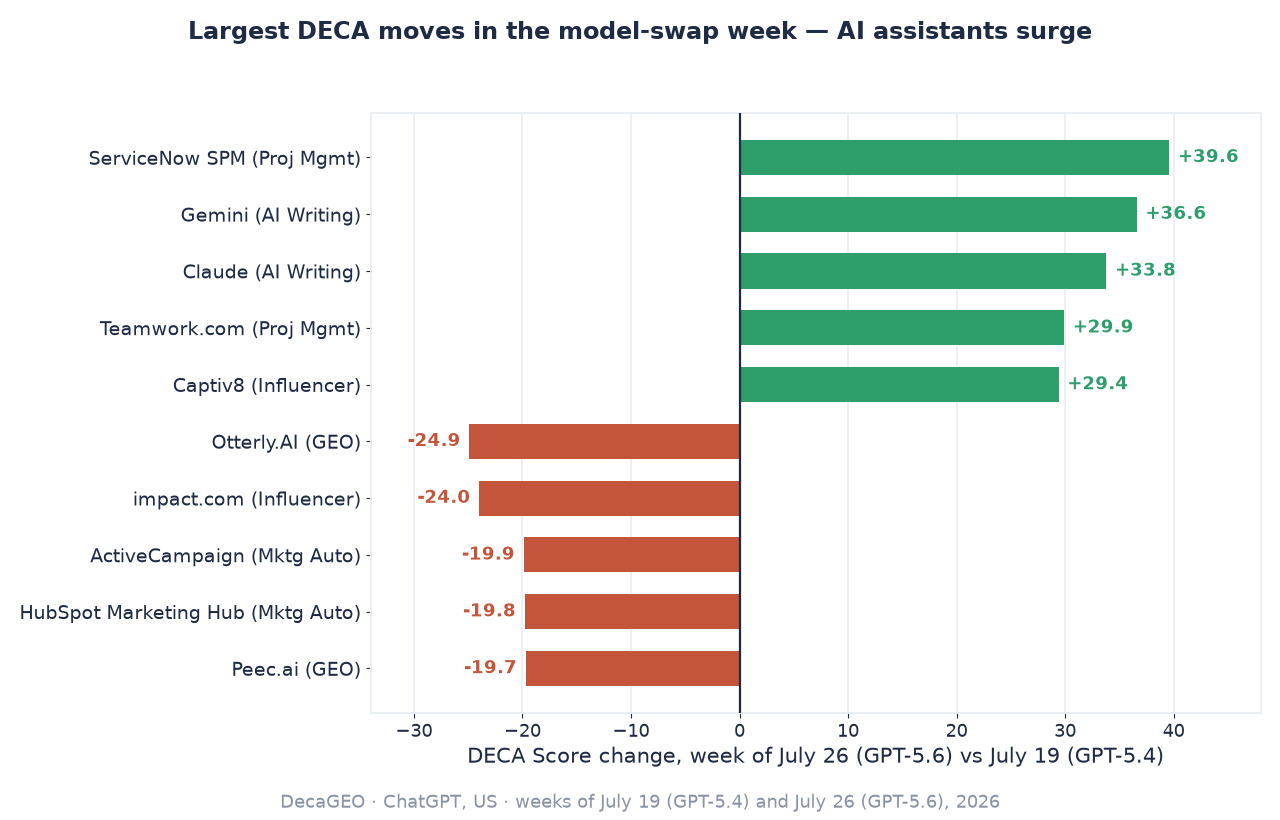
Largest DECA Score moves, week of July 26 (GPT-5.6) vs July 19 (GPT-5.4), 2026. Source: DecaGEO, ChatGPT, US.
ChatGPT’s recommendation set fell below its GPT-5.4 range (445 → 399)
The number of brands ChatGPT placed in its recommendation set fell from 445 to 399 at the model boundary — 46 fewer slots, below the lowest GPT-5.4 week (439). The cut was not uniform. GEO lost 51 net brands, Influencer Marketing 11, and Email 4, while AI Writing added 10 and AI Image 8.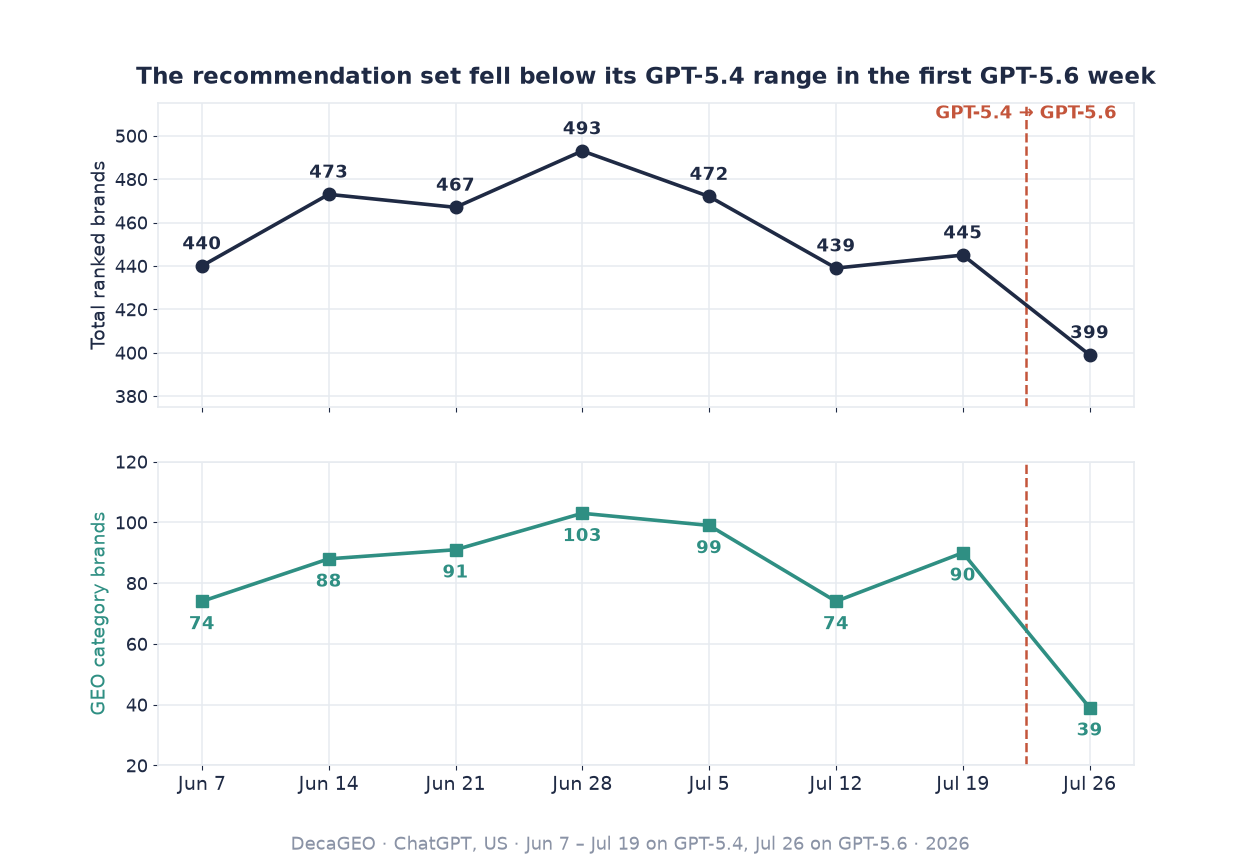
Total ranked brands and GEO category brands, weeks of June 7 – July 26, 2026. Weeks through July 19 collected on GPT-5.4, July 26 on GPT-5.6. Source: DecaGEO, ChatGPT, US.
Table 2: Ranked brands per category, weeks of June 21 – July 26, 2026. The July 26 column is the first GPT-5.6 collection; earlier columns are GPT-5.4. Source: DecaGEO, ChatGPT, US.
Read the July 26 column against each row’s full range, not its last cell — four categories sit below their GPT-5.4 bands and two sit above. Any of these may be a result of the model change rather than category movement. The next GPT-5.6 weeks will show which levels are the new normal and which were one-week noise.
Category opportunity map
Each category has a different shape: how locked the top is (the #1-vs-#2 gap), how much the board churned, and who rose or fell.
Table 3: As of the week of July 26, 2026 · ChatGPT (GPT-5.6), US. Risers and fallers by DECA Score change vs July 19 (GPT-5.4) — changes cross the model boundary.
Open any category’s live board: CRM, SEO, GEO, Email Marketing, Marketing Automation, Project Management, Help Desk, Influencer Marketing, AI Writing Assistants, AI Image Generators.
The top of the board compressed this week. Help Desk’s gap collapsed from 26 to 2 as Freshdesk rose +24.4 to sit just behind Zendesk Suite, and four categories now show a single-digit #1-vs-#2 gap (Help Desk, Project Management, CRM, Influencer Marketing) against two last week. At the other end, SEO’s gap widened from 45 to 60 — Semrush’s largest lead on record in our tracking. SEO also churned most (13 of 61 brands moved ±10 ranks), while CRM did not move a single brand ±10 for the second week running.
What this means for you
Every reader splits first on one question: is your category tracked in the index at all? If it isn’t, the next section covers what to do. If it is, read your position:- Not yet recommended. The open boards shifted with the model change: AI Writing and AI Image added slots (10 and 8 more than last week), while GEO’s board shrank by more than half. If your brand isn’t on a board yet, Add Your Brand sends a weekly alert the moment it enters the recommendation set, so you don’t have to keep checking manually.
- Mid-pack. Resist reacting to this week’s score changes, which mix the model change with real movement. A brand’s chart history shows whether a move survives into the coming GPT-5.6 weeks, which is the only reading that matters right now.
- Stable or leading. Two six-week incumbents (monday Work Management, CreatorIQ) lost their #1 in a single week, and four categories now have single-digit gaps at the top. If you lead your category, compare your brand against challengers weekly — model transitions are when leads get re-tested.
Don’t see your category?
Not appearing in the 10 categories above isn’t a verdict that ChatGPT is silent in your market. It more likely means the category hasn’t been mapped yet. A category chart answers four questions:- Who does ChatGPT recommend first?
- Which brands are entering the recommendation set?
- How high is the Top 5 threshold (the DECA Score needed to break in)?
- Is the category open, volatile, or locked?
FAQ
Did ChatGPT’s brand rankings change when GPT-5.6 replaced GPT-5.4?
At the top, yes. Three of ten category #1s changed hands in the first GPT-5.6 week (Marketing Automation, Project Management, Influencer Marketing), against one to two changes in every GPT-5.4 week. Overall rank churn stayed in the normal range: 12.5% of brands moved ±10 ranks, within the GPT-5.4 range of 9.9–12.9%.Which brand gained the most in ChatGPT recommendations this week?
ServiceNow Strategic Portfolio Management, up 39.6 DECA points to #7 in Project Management, for the week of July 26, 2026. Three of the six largest gains were general-purpose AI assistants in AI Writing: Gemini (+36.6), Claude (+33.8), and Microsoft 365 Copilot (+28.5).Why did the number of recommended brands drop this week?
The tracked recommendation set fell from 445 to 399, below its six-week GPT-5.4 range (439–493), led by GEO (90 → 39). The pipeline was unchanged, so the drop may be a result of the GPT-5.6 model change, but it is not established as caused by it. The coming GPT-5.6 weeks will show whether the smaller set is the new level or one-week noise.Did the Marketing Automation #1 change again?
Yes. Braze retook #1 from HubSpot Marketing Hub, whose time at the top lasted exactly one week. HubSpot Marketing Hub fell to #3 (80.2), with Customer.io at #2.Did the CRM leader change?
No. Dynamics 365 Sales held #1 for a third straight week, though its gap narrowed from 18 to 7 points as HubSpot Sales Hub rose to #2 (92.9). CRM was also the calmest board for a second week: none of its 24 brands moved ±10 ranks. See Best CRM Software.Which category is most volatile right now?
SEO, where 13 of 61 brands moved ±10 ranks. GEO’s turbulence showed in membership instead: 18 brands entered and 69 exited, cutting its board from 90 to 39.How should I read week-over-week numbers across a model change?
As measurements of two things at once — the market and the model. Compare each figure against the full GPT-5.4 range rather than last week alone, treat out-of-range values as candidate model effects rather than brand performance, and wait for the coming GPT-5.6 weeks to separate transient from persistent. Normal week-over-week reading resumes with the week of August 2 report.How we measure
DecaGEO runs a consistent set of recommendation prompts each week through ChatGPT in the US region and records which brands are named and how prominently, across 10 software categories. This week’s data was collected on July 23, 2026 on GPT-5.6 (model labelgpt-5.6-terra), the first collection after OpenAI retired GPT-5.4 on July 23. The prompt grid and volume were identical to the GPT-5.4 runs: 714 responses and 714 unique queries in both weeks compared here.
- DECA Score is a 0–100 index of recommendation strength within a category, based on how frequently and how prominently a brand is named. Scores are normalized weekly so each category’s leader sits at 100. A score change therefore reads as a change in the gap to the leader, not an absolute shift.
- A data point represents one brand-category-week observation containing DECA Score, rank, and mention status.
- Model labels (e.g., GPT-5.6) reflect the visible model identifier at the time of each weekly collection, not independently verified model versions.
- Model boundary. This report compares a GPT-5.6 week against a GPT-5.4 week. Differences are read against the six-week GPT-5.4 range (not last week alone), treated as possible results of the model change rather than established causes, and re-checked in subsequent GPT-5.6 weeks. Rank-move counts (±10) are computed among brands present in both weeks (283 this week).
- Limitations: Week-over-week counts partly reflect newly detected brands and may include re-aggregation noise. A single week’s change is an observation, not a trend. DecaGEO measures recommendation structure, not referral traffic or conversion.
Sources
- DecaGEO recommendation data, ChatGPT, US, weeks of July 19 (GPT-5.4) and July 26 (GPT-5.6), 2026 (10 categories).
- GPT-5.4 baseline ranges: DecaGEO weekly data, weeks of June 14 – July 19, 2026.
- Prior week: AI Ranking Movers — Week of July 19, 2026.
- Model boundary analysis: GPT-5.6 vs GPT-5.4: How ChatGPT’s Search & Citation Behavior Changed.
Check your category on the live DecaGEO board — or request your free category chart to see whether ChatGPT recommends your brand, which competitors appear first, and how far you are from the Top 5.