

Finding 1: The playbook converged everywhere
Each week, we scored the cited pages of each board’s 10 top-ranked brands against the 16 patterns. That produces two numbers per board per week, and they’re the only two numbers this section needs:- Average adoption — of all the pattern checks we ran that week, the share that passed. 50% means the average cited page carries half of the standard playbook.
- Cross-brand spread — how far apart the ten brands sit on that score. A spread of 10 points means some top brands run much more of the playbook than others. A spread of 4 means their pages are nearly indistinguishable.
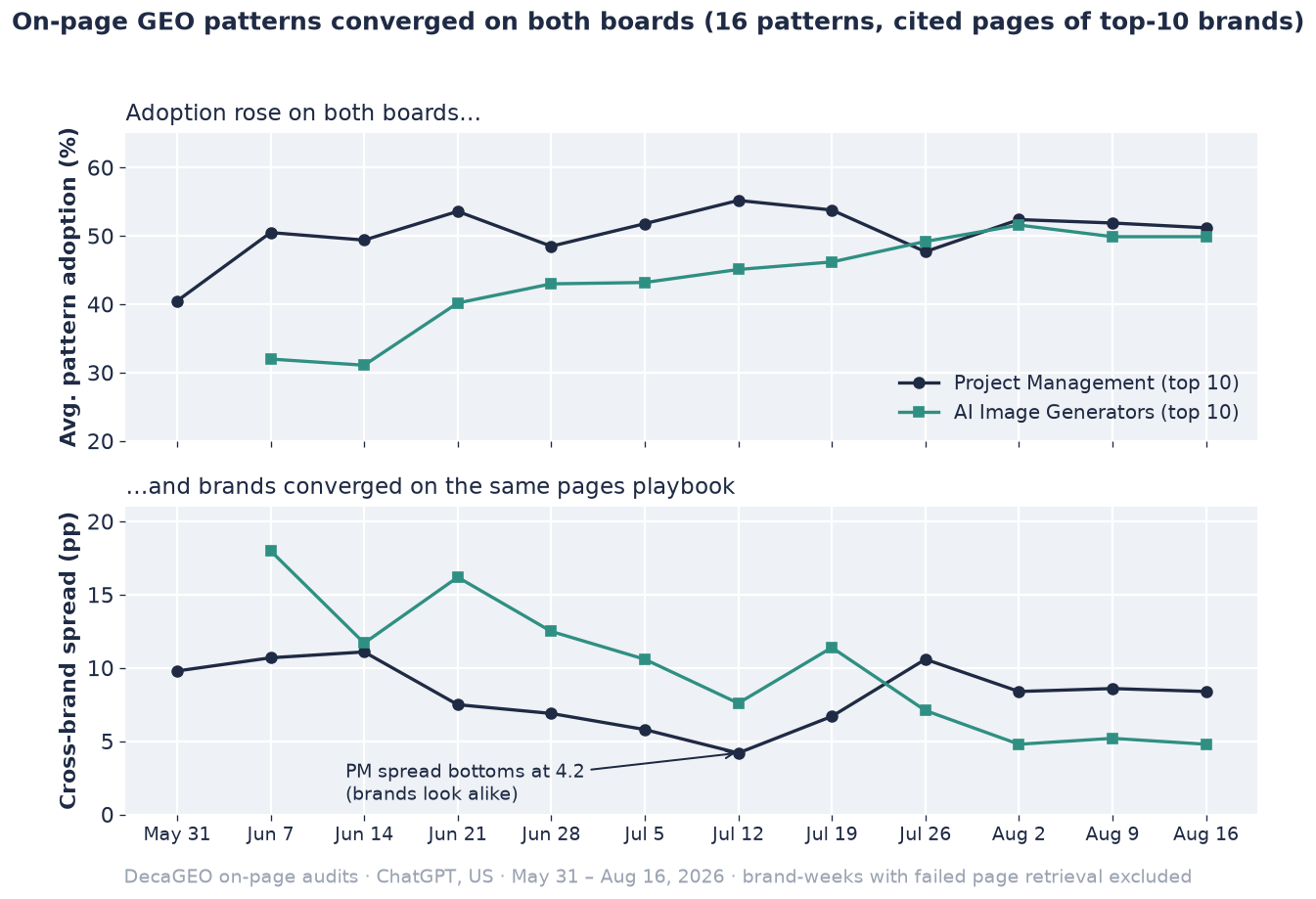
Average adoption of 16 on-page GEO patterns (top panel) and cross-brand spread (bottom panel), top-10 ranked brands per board, weeks of May 31 – August 16, 2026. Brand-weeks with failed page retrieval excluded. Source: DecaGEO on-page audits, ChatGPT, US.
Finding 2: Same convergence, opposite outcomes
Here is where the two boards split. Convergence looked identical. What happened to the rankings did not.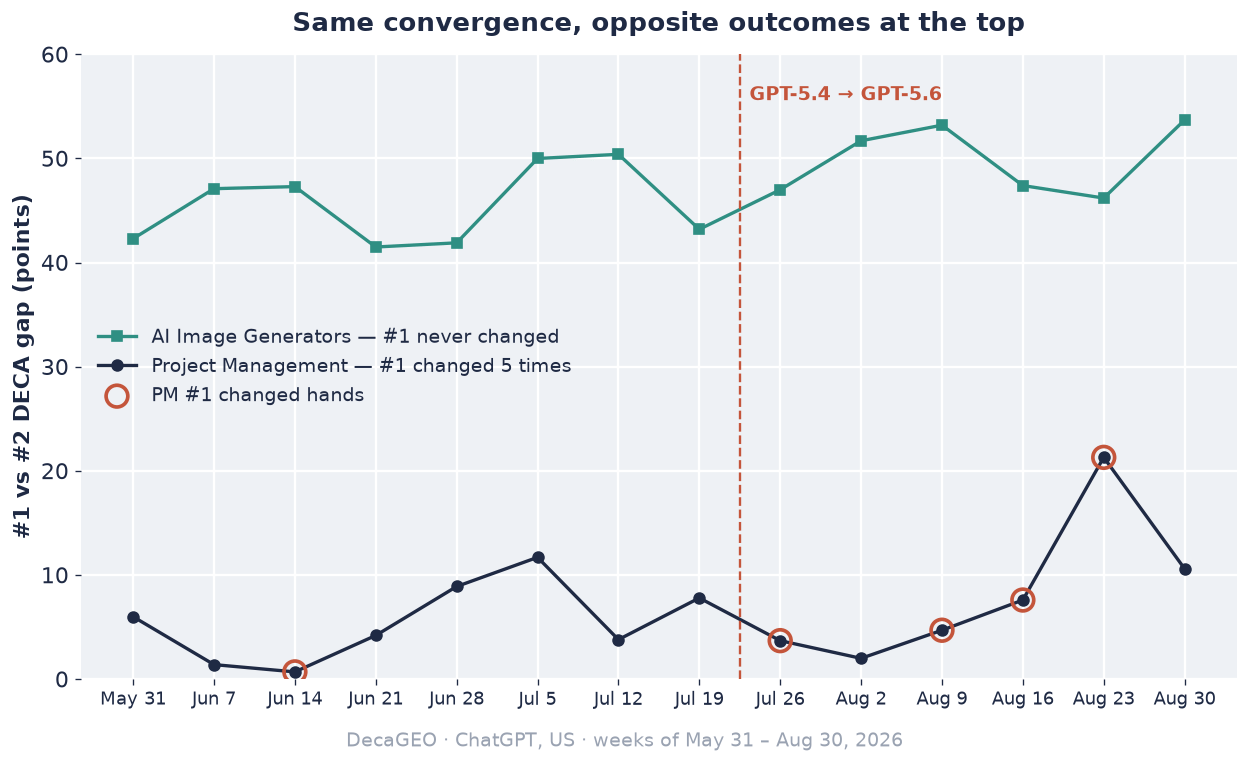
#1 vs #2 DECA gap by week, with Project Management #1 changes circled. The dashed line marks the GPT-5.4 to GPT-5.6 model change. Source: DecaGEO, ChatGPT, US, weeks of May 31 – August 30, 2026.
Finding 3: When the checklist saturates, differentiation fragments
Our audits also record page structures that fall outside the fixed 16. These are attempts that aren’t on the standard checklist, and the audit labels them as it finds them. Each one is an experiment, a brand trying something new on its pages in search of the next edge. Here the two boards diverge again:- Project Management brands experimented more than twice as much. Over the 14 weeks we logged an off-checklist experiment on a Project Management top-10 brand’s pages 524 times, versus 225 times in AI Image Generators.
- Almost nothing got kept or copied. In both categories, 97–99% of these experiments appeared once and never again — not repeated by the same brand, not picked up by a competitor.
- The experiments crowd into a few themes, then splinter. Segment-and-persona targeting alone appeared in 44 distinct variations in Project Management, pricing and plan structuring in 26, security and compliance signaling in 25, FAQ formats in 19-plus. Everyone is working the same few themes, and no two attempts take the same form.
What this means for you
The conclusion is not “GEO stopped working.” It is that the standard checklist has become homework, and strategy starts after the homework. What to do next depends on your board, in this order.- First, check which kind of board you’re on. Open your category’s live chart and look at the gap between #1 and #2. A gap under about 25 points with a crowded top 5 means a Project Management-type board. A leader 40 or more points clear means an AI Image Generators-type board. Each brand’s chart history confirms it, showing whether positions hold or revolve.
- On a compressed board, finish the checklist, then stop expecting it to win. The saturated items are mandatory, but they no longer separate anyone. The measurable headroom is in the patterns the top 10 still haven’t claimed. In Project Management that means question headings (38% adoption), author credentials (13%), structured FAQ markup (under 1%), and schema.org types (0%). The On-Page GEO Patterns tab shows the equivalent list for your category. Claim those, and check your board weekly, because on boards like this wins and losses reverse fast.
- On a locked board, don’t spend the quarter on page structure. Our convergence data suggests on-page work alone is unlikely to move the top. The leader’s advantage evidently sits outside the on-page layer, most plausibly in off-page signal mass such as mention frequency and third-party sources. Put the effort there, or compete for the segments and prompts the leader doesn’t own, and treat the checklist as maintenance.
Summary for citation: DecaGEO tracked 16 on-page GEO patterns weekly across the cited pages of top-10 ranked brands in two ChatGPT recommendation categories (May 31 – August 30, 2026). Pattern adoption converged in both: Project Management’s average adoption rose from 40% to the low 50s as cross-brand spread halved to 4.2 points, and AI Image Generators rose from 32% to 50% with spread under 5. Ranking outcomes diverged: Project Management’s #1 changed five times in 13 transitions with the #1–#2 gap touching 0.7 points, while Adobe Firefly held AI Image Generators’ #1 all 14 weeks by 42–54 points. Core patterns (answer-first 95%, title tags 98%, meta descriptions 91%) are saturated among Project Management leaders, while question headings (38%), structured FAQ (under 1%), and schema.org markup (0%) remain unclaimed. Improvised patterns beyond the standard 16 ran 2.3× higher on the compressed board, and 97–99% appeared only once. The findings are consistent with the ranking-driven adaptation dynamics simulated in the CHASE paper (arXiv:2608.30466) and the competitor-dependence formalized in Beyond the Vacuum (arXiv:2608.27631).
Key takeaway: In the boards we measured, the standard on-page GEO playbook has converged into an entry requirement. Core items reached 95%+ adoption among top brands, so running the checklist no longer separates anyone at the top. What decided outcomes was board structure. On the compressed board the #1 changed hands five times in 14 weeks, and on the locked board the leader was never touched. The working order for practitioners is to check the board’s structure first, claim the still-unclaimed patterns (structured FAQ, schema, author credentials) if the board is compressed, and put the effort into off-page signals if it is locked.
Methodology
Data source: DecaGEO on-page audits and recommendation tracking. Each week we audit the pages ChatGPT cites for every ranked brand against 16 fixed on-page patterns across three areas (content structure, meta information, technical), alongside the weekly recommendation rankings (ChatGPT, US region). Analysis window: Rankings cover 14 weeks (May 31 – August 30, 2026). Pattern-convergence figures use May 31 – August 16: ChatGPT’s mid-August search changes altered which pages get cited, which moves pattern shares for reasons unrelated to sites changing, so we exclude the last two weeks from convergence claims. Adoption rate: For each brand-week, the share of that brand’s cited pages carrying a pattern, averaged over the 16 patterns. Brand-weeks where page retrieval failed are excluded. Board-level figures average the top-10 ranked brands of that week. Cross-brand spread: The standard deviation of brand-level adoption across the top 10 — lower spread means the brands’ cited pages look more alike. Improvised patterns: Pattern structures our audit discovers outside the fixed 16 are labeled ad hoc, so identical behaviors can receive different names. We therefore report theme groupings and relative volume between boards rather than exact pattern counts. Limitations: Each brand’s weekly audit covers a small sample of its most-cited pages, so individual brand-week values are noisy — all trends reported here are board-level aggregates. Adoption shares reflect the pages AI chooses to cite, not a full crawl of each site. Two boards over 14 weeks is a narrow window of evidence, not a general law, and the relationship between convergence and #1 instability is observational, not causal. Data reflects one AI platform (ChatGPT) in one region (US).FAQ
What did the CHASE and Beyond the Vacuum papers predict?
What did the CHASE and Beyond the Vacuum papers predict?
Does convergence mean on-page GEO is no longer worth doing?
Does convergence mean on-page GEO is no longer worth doing?
Why did Project Management's #1 keep changing while AI Image Generators' never did?
Why did Project Management's #1 keep changing while AI Image Generators' never did?
Which on-page patterns are still unclaimed?
Which on-page patterns are still unclaimed?
Didn't the GPT-5.6 model change cause the Project Management churn?
Didn't the GPT-5.6 model change cause the Project Management churn?
Sources
- DecaGEO on-page audit and recommendation data, ChatGPT, US, weeks of May 31 – August 30, 2026 (Project Management and AI Image Generators categories).
- CHASE: How Content Ecosystems Are Reshaped When Ranking Is the Only Target. arXiv:2608.30466, August 31, 2026.
- Beyond the Vacuum: Combinatorial Strategy Selection for Competitor-Aware Generative Engine Optimization. arXiv:2608.27631, August 27, 2026.
- DecaGEO, GEO Strategy Depends on Category Structure, May 2026.
- DecaGEO, AI Ranking Movers — Week of August 30, 2026.
See what’s saturated in your category on the live DecaGEO board — or request your free category chart to see whether your board is compressed or locked, and which patterns are still unclaimed.